Mobile detailing in London
Every service below is carried out at your address in London — home, office or yard — with the vehicle staying exactly where it already sits. London sits on Highway 401 and Highway 402, and that mileage is what shows up on the paint. Sustained highway speed drives grit into the front bumper and the leading edge of the bonnet far harder than town driving does, and it lays a bonded road film across the lower panels that an ordinary wash lifts off the surface while leaving the rest keyed in. Cars here need decontaminating more often than their mileage alone suggests.
Every service, at your address in London.
Ten services, each with its own page. Nothing on this page repeats what those pages already explain — it tells you what is different about having them done in London.
Interior Detailing
Seats, carpets, vents and glass, extracted and finished at your address.
See interior detailing →Exterior Detailing
Two-bucket contact wash, decontamination, wheels and a protective sealant.
See exterior detailing →Full Detailing
Interior and exterior in one appointment, in the order that makes the result last.
See full detailing →Ceramic Coating
A coating applied and levelled by hand, after the paint has been prepared for it.
See ceramic coating →Paint Correction
Machine polishing that removes swirls and light scratches rather than filling them.
See paint correction →Paint Protection Film
Film fitted to the panels that take the stone chips first.
See paint protection film →RV Detailing
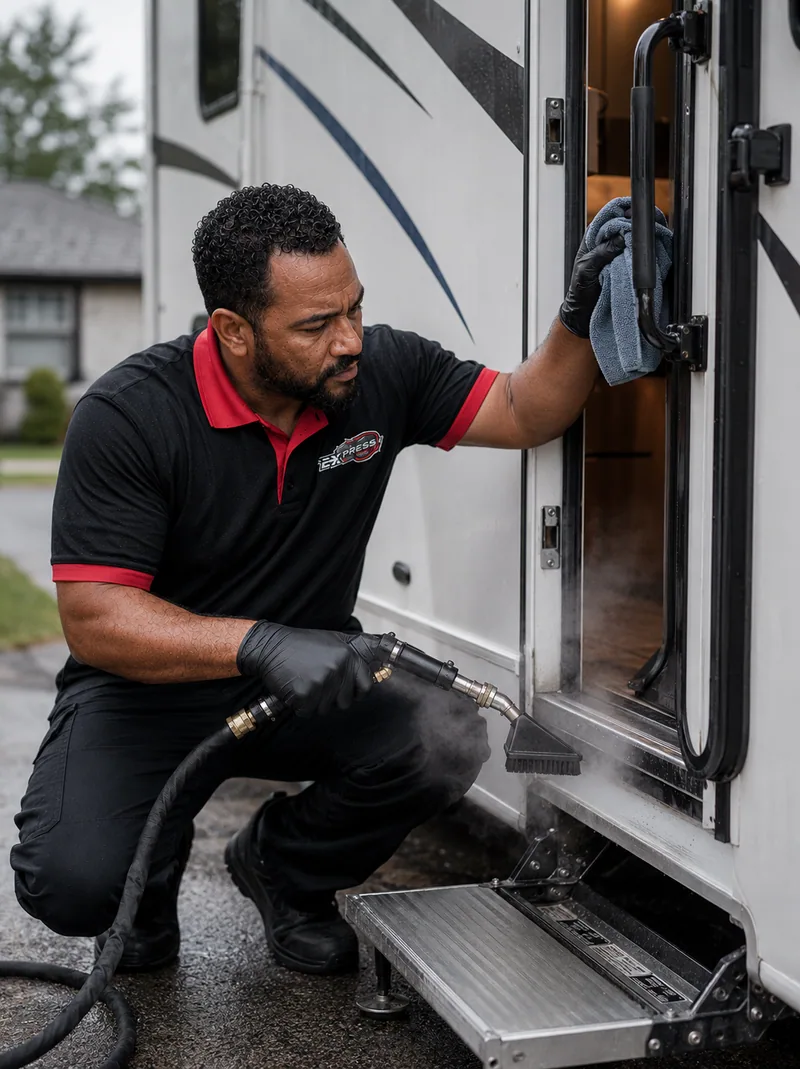
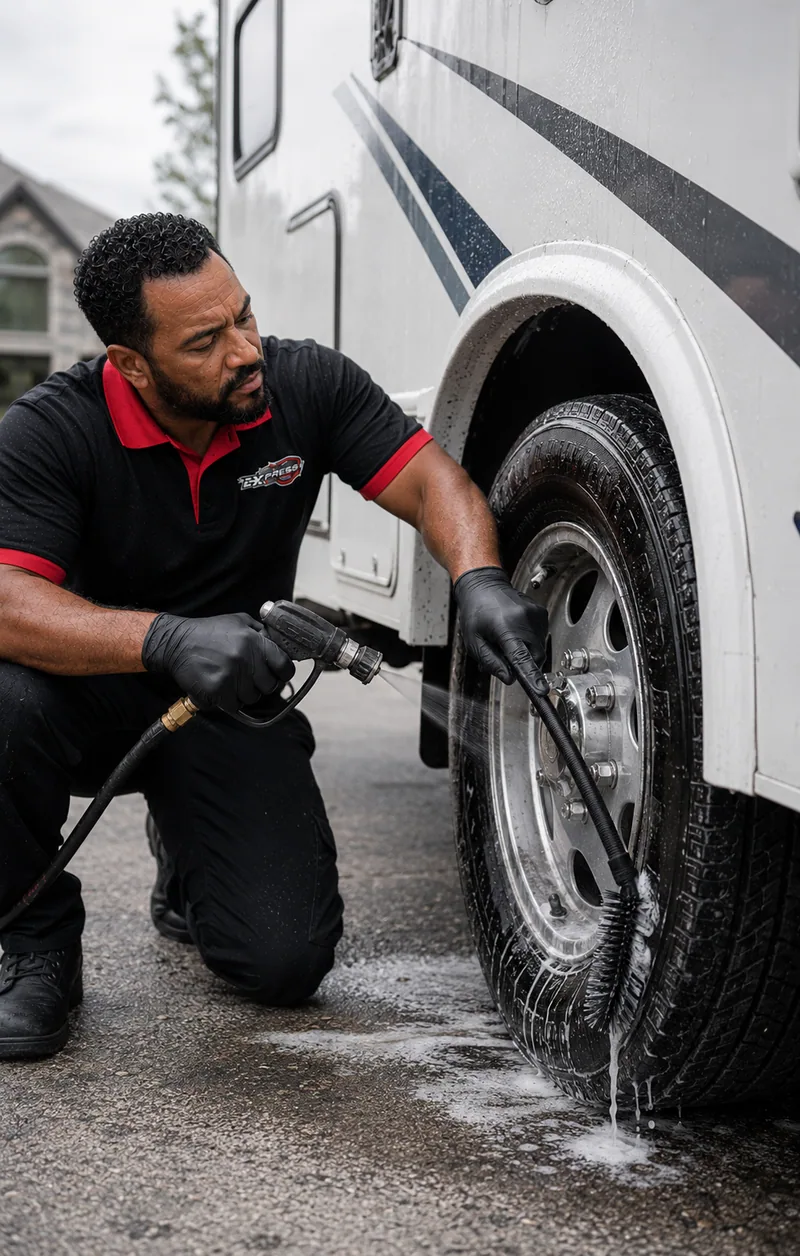
Roof, sidewalls and the living space, quoted by the foot.
See rv detailing →Boat Detailing
Gel coat, vinyl and the cabin, on the trailer or at the slip.
See boat detailing →Truck Detailing
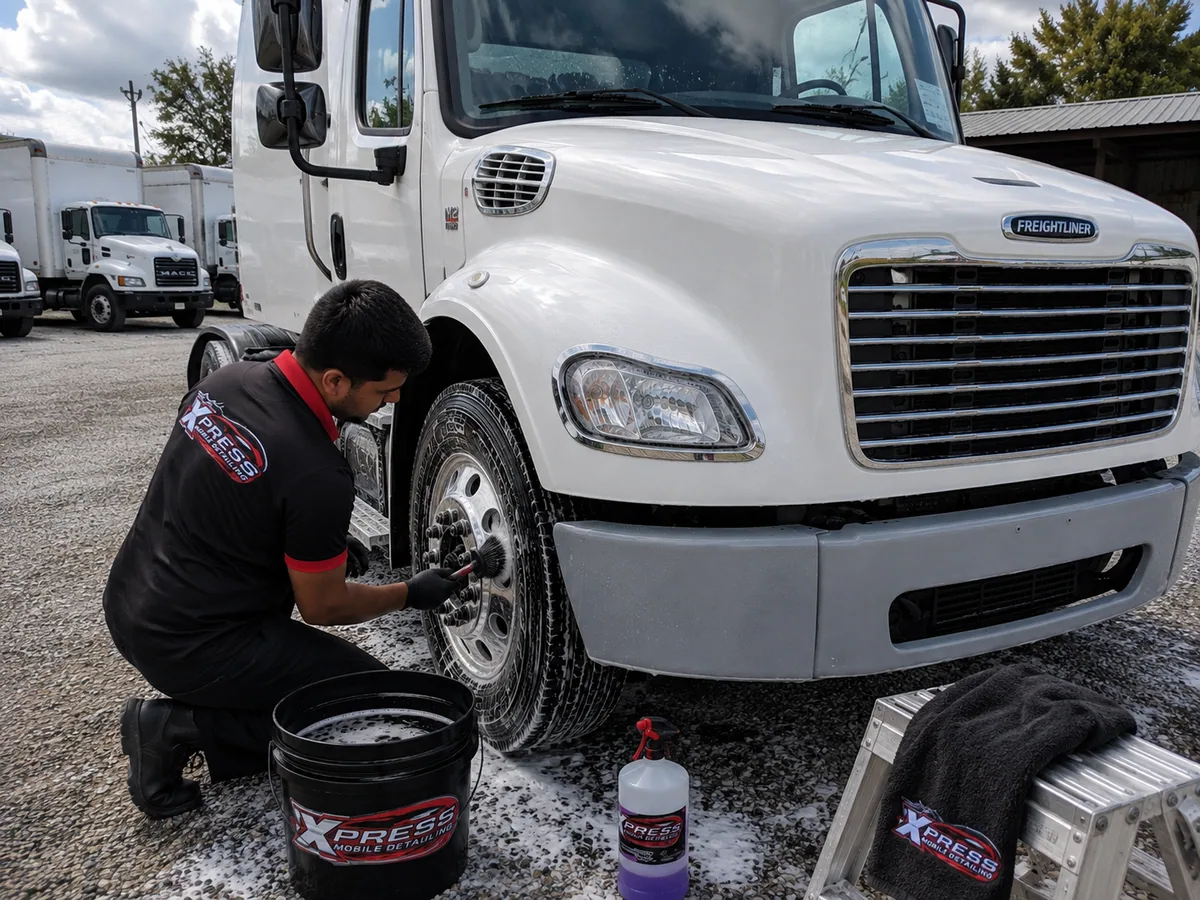
Cab, sleeper and exterior, sized by cab type rather than by vehicle class.
See truck detailing →Fleet Detailing
Scheduled work across a yard, priced per vehicle and per visit.
See fleet detailing →Each service, written for London
Nine pages, one per service, covering what is different about having it done here — access, conditions and the local rules that decide how an appointment is planned.
Which service fits a vehicle here.
The services are the same everywhere. What changes between places is which one is overdue first, and why.
Highway miles, so decontamination before protection
Highway 401 exposure means bonded road film and brake dust rather than loose dirt, and protection applied over that traps it. The order that works here is exterior detailing first, then ceramic coating or paint protection film once the paint is actually clean.
Drier air, so interiors are about grit rather than damp
London sits inland, so cabins here dry normally and the interior problem is what gets walked in — grit in the carpets and seat bases. That is interior detailing work, and extraction rather than a vacuum.
Vehicles that are not cars
The same visit logic applies to RVs, boats and trucks in London — they are quoted differently (by the foot, or by cab type) but they are still done where the vehicle stands. Fanshawe Conservation Area lists Fishing and Boating and Canoe and Kayak Rentals among its offerings, and the Upper Thames River Conservation Authority describes the conservation area's boat launch being used to get watercraft on and off the reservoir. For more than one vehicle at a time, that is fleet detailing.


What London does to a vehicle.
Winter salt, and the weeks after it. Ontario salts heavily and Middlesex County gets a full season of it. Salt does its worst work where nobody inspects — inside the wheel arches, along the lower valance, in the seams under the doors — and it keeps working through the first warm weeks after the roads are clear, which is when most people assume the risk has passed. On a vehicle doing motorway miles all winter that is a corrosion timeline rather than a cosmetic one.
Check availability in London →
The vehicle never leaves your driveway
A good proportion of vehicles in London live in underground or covered parking, which is genuinely protective — less UV, less freeze-thaw, less bird and sap damage. It also means the vehicles that DO live outside here are the ones taking the full load, and the difference between two cars of the same age in the same postcode can be dramatic.
Booking in London.
Book the slot
Pick the service and tell us where the vehicle will be in London. Access is the variable that matters most here. A lot of vehicles live in underground or shared parking with height restrictions and time-limited visitor bays, and that is worth settling when you book rather than on the day — it is the single most common reason a city appointment has to be rescheduled.
We arrive equipped
The technician arrives with professional equipment and works around the vehicle where it stands — nothing is driven anywhere.
Walk the result
Anything missed is put right on the spot rather than on a second visit.
Coming to London
London is inside our regular Ontario coverage, so a technician comes to the address you book. The service price itself is the same wherever we work.
What is specific to London.
These come from the municipality's own pages, linked so you can check them rather than take our word for it.
The City of London states that overnight parking is permitted during the summer and into the fall until November 15. Overnight parking passes are available between November 15 and March 31, weather permitting, for personal vehicles; a maximum of 15 free overnight parking passes will be issued per vehicle licence plate, valid on most City streets. Passes applied for before midnight start at midnight on the next calendar day, and passes applied for between midnight and 5 a.m. are selected for the current day. Overnight parking is prohibited on certain streets and passes cannot be used where parking is prohibited year-round. If a snow event is forecast, a message will be posted on the overnight parking registry and no on-street parking will be allowed.
Fifteen free overnight passes a year sounds generous, and it is — until a snow event is forecast, at which point a notice goes up on the registry and no on-street parking is allowed at all, pass or no pass.
Overnight on-street parking — City of London — accessed 2026-08-20
Fanshawe Conservation Area lists Fishing and Boating and Canoe and Kayak Rentals among its offerings, and the Upper Thames River Conservation Authority describes the conservation area's boat launch being used to get watercraft on and off the reservoir.
There is real boating water here — the conservation area on the reservoir offers fishing and boating with canoe and kayak rentals, and has a launch used to get watercraft on and off the water.
Fanshawe Conservation Area — accessed 2026-08-20
The City of London states that crews use a minimal amount of salt, that it salts only significant streets and core pedestrian areas to prevent snow and ice from sticking to the road, that the City reserves sand use for local streets at intersections, curves and hills to provide traction, and that typically it does not sand the entire road. Spot sanding is also used for sidewalks when the City becomes aware of icy or slippery conditions, and it does not usually sand the whole path. The City also uses anti-icing technology to prepare streets before a storm to help prevent snow or ice sticking to roads.
This city uses deliberately little salt, and it sands local streets only at intersections, curves and hills rather than along their whole length — so the material a car picks up is concentrated exactly where it turns, stops and climbs.
Winter maintenance — City of London — accessed 2026-08-20
The City of London publishes snow clearing standards by snowfall class. Class 1, when there is less than five centimetres of snow: roads are completed within four hours after the end of a snowfall (salting/sanding only) and bike lanes within eight hours. Class 2, when there is five centimetres of snow: roads are cleared within six hours after the end of a snowfall and sidewalks within 48 hours. Class 5, when there is ten centimetres of snow: roads are cleared within 24 hours, bike lanes within 24 hours, sidewalks within 48 hours, and bus stops within 72 hours after sidewalks. The City states sidewalks are a priority and that because crews clear bus stops using the same equipment they finish those afterwards.
The clearing standard here scales with how much actually fell: under five centimetres the roads are done inside four hours, at five centimetres it is six, and at ten it becomes a full day — so the depth in the forecast tells you fairly precisely when the city will be moving again.
Winter maintenance — City of London — accessed 2026-08-20
The Upper Thames River Conservation Authority states that the primary purpose of Fanshawe Dam and Reservoir is to assist in flood control efforts to reduce flood damage in the City of London; that throughout most of the year the amount of water released from the reservoir equals the amount entering from upstream, but during a flood less water is released than comes in so the reservoir gradually fills; that Fanshawe Dam has reduced damages from significant floods at least a dozen times in the past five decades; and that although historically most severe floods on the Thames River system occurred during the spring snow melt, the most severe floods ever recorded occurred in late spring or fall from extremely heavy or prolonged rainfall. Under normal non-flood operating conditions the reservoir is 6.4 km long, up to 0.8 km wide and up to 12.5 m deep, with a surface area of 2.61 square kilometres. There are three major flood control dams in the UTRCA watershed as well as a major dyke system in London including the West London Dyke.
The reservoir here is a working flood-control structure rather than a fixed lake — through most of the year what goes out matches what comes in, but during a flood it is deliberately held back and the level rises. Spring melt is the classic trigger, which is worth knowing if a boat has to come off or go on the water around then.
Fanshawe Dam & Reservoir — Upper Thames River Conservation Authority — accessed 2026-08-20

Also served across Middlesex County.
Every place listed here is quoted by the same booking calculator.
London, on the day.
Recent work from the vans that cover London and the rest of Middlesex County.


London, answered.
Do you actually come to London?
Yes. London is inside the regular Middlesex County service area, which is why the booking calculator quotes it directly instead of asking for a custom quote.
Do you cover London?
London is inside our regular Ontario coverage, so you can book it directly. Your full quote is confirmed before you approve the booking, so the quote you see is the quote you pay.
Where can the vehicle be parked while you work in London?
The City of London states that overnight parking is permitted during the summer and into the fall until November 15. Overnight parking passes are available between November 15 and March 31, weather permitting, for personal vehicles; a maximum of 15 free overnight parking passes will be issued per vehicle licence plate, valid on most City streets. Passes applied for before midnight start at midnight on the next calendar day, and passes applied for between midnight and 5 a.m. are selected for the current day. Overnight parking is prohibited on certain streets and passes cannot be used where parking is prohibited year-round. If a snow event is forecast, a message will be posted on the overnight parking registry and no on-street parking will be allowed. Fifteen free overnight passes a year sounds generous, and it is — until a snow event is forecast, at which point a notice goes up on the registry and no on-street parking is allowed at all, pass or no pass. A driveway, a private lot or a building's parking level all work; tell us which when you book so the slot is not spent moving the vehicle.
When is the best time to book exterior work in London?
Straight after the salt season ends is the appointment that does the most good — that is when the winter's residue is still sitting in the arches and seams and has not had a summer to set into the finish. A second visit before winter, to put protection on ahead of the salt, is the other one that genuinely pays for itself in Middlesex County.
Why does my interior smell even though it looks clean?
Because odour lives in the fabric rather than on the surfaces. Spills soak into carpet and upholstery and stay there, and a vehicle that looks tidy can still be holding months of it. Extraction reaches what wiping and vacuuming cannot.
Book a detail in London
Pick the service, tell us where the vehicle is, and the full quote is shown before you confirm.
Start your booking